
Cex vs Dex
12 March 2026 • 9 Min ReadCentralized exchanges (CEXs) and decentralized exchanges (DEXs) represent two distinct models for facilitating the trading of cryptocurrencies and digital assets. While both function as platforms for asset exchange, they differ fundamentally in terms of custody, governance, user control, regulatory compliance, and risk exposure. This article outlines the core characteristics of each model, compares their advantages and limitations, and examines their roles within the broader cryptocurrency ecosystem.
What Is a Centralized Exchange (CEX)?
A centralized exchange (CEX) is a platform that facilitates the trading of digital assets through a system managed by a central authority, usually a registered company. These exchanges operate similarly to traditional brokerage services, providing user accounts, managing order books, and often holding users’ assets in custodial wallets.
Centralized platforms such as Binance, Coinbase, and Kraken are known for offering high liquidity, fast execution, and user-friendly interfaces. They frequently support fiat-to-crypto transactions and provide features such as margin trading, staking, and advanced order types.
However, their custodial nature means users must entrust the platform with their funds. This introduces potential security and operational risks, such as hacking or temporary withdrawal limits. Additionally, regulatory compliance requires centralized exchanges to implement Know Your Customer (KYC) verification, which can limit privacy.

What Is a Decentralized Exchange (DEX)?
A decentralized exchange (DEX) enables users to trade cryptocurrencies directly from their wallets by interacting with smart contracts on a blockchain. Unlike centralized platforms, DEXs do not rely on a central operator or hold users’ assets; instead, trades are executed peer-to-peer.
DEXs, such as Uniswap, PancakeSwap, and SushiSwap, operate on networks like Ethereum or BNB Chain, offering an open and permissionless environment. This approach gives users greater control over their funds and removes the need for identity verification, appealing to those who prioritize privacy and autonomy.
Despite these advantages, DEXs often require a higher level of technical knowledge. Users must manage their own wallets, navigate complex interfaces, and pay transaction fees associated with blockchain transactions. Liquidity can also vary across assets, and the absence of customer support means users bear full responsibility for their interactions.
CEX vs DEX: Structural Overview
| Feature | Centralized Exchange (CEX) | Decentralized Exchange (DEX) |
| Custody of Funds | Held by the platform | Held by the user |
| Control Model | Operated by a central authority | Governed by smart contracts and protocols |
| User Registration | Requires KYC and identity verification | Usually does not require registration |
| Access Method | Account-based access via login credentials | Wallet-based access (e.g., MetaMask) |
| Liquidity | Generally high, especially for major assets | Varies by token and platform |
| Fiat Support | Common (bank transfers, credit cards) | Rare; mostly crypto-to-crypto |
| Interface Design | Typically user-friendly and polished | Can be complex or technical for newcomers |
| Regulatory Status | Often licensed and regulated | Largely unregulated (varies by jurisdiction) |
| Security Risk | Prone to centralized hacks and custodial failures | No custodial risk, but smart contract risk exists |
| Support Services | Offers customer support | No formal support; self-service only |
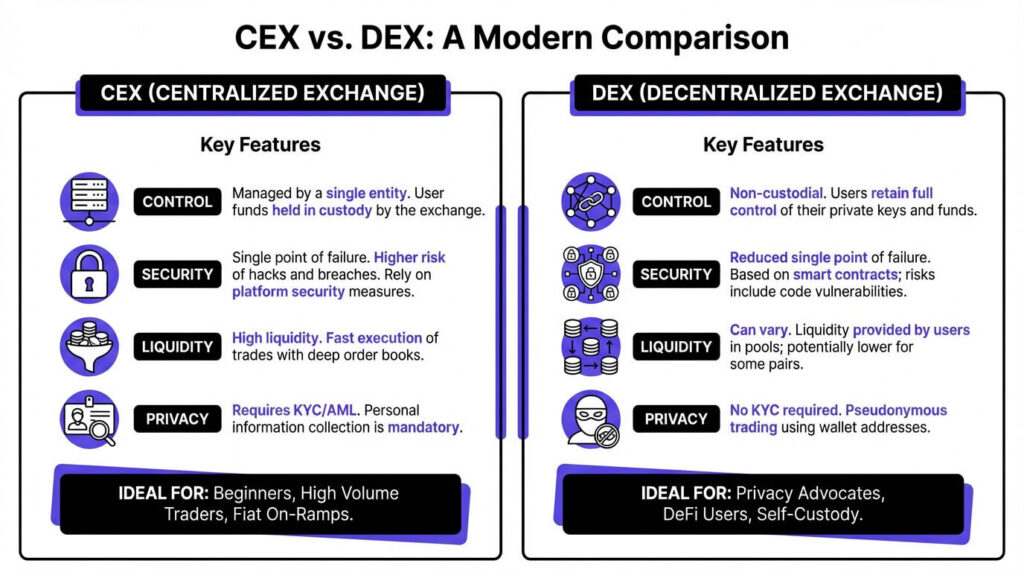
CEX vs DEX: A Head-to-Head Comparison
Although centralized and decentralized exchanges serve the same core purpose, enabling the trading of cryptocurrencies, their operational frameworks differ significantly. These differences influence not only how users interact with them, but also how risk, accessibility, and functionality are distributed.
Custody and Control
Centralized exchanges take custody of user funds and manage transactions internally. This custodial model can simplify the trading experience but introduces risks associated with centralized control. In contrast, decentralized exchanges allow users to retain control over their assets by connecting directly through their wallets. Trades are executed via blockchain smart contracts, with no intermediaries involved.
Security and Risk Profile
Security considerations vary between models. CEX platforms are attractive targets for hackers due to their asset concentration, but they typically employ strong security infrastructure. DEXs avoid this centralized risk by design; however, they depend on the integrity of their smart contracts, which can contain exploitable vulnerabilities if not properly audited.
Liquidity and Market Depth
Centralized exchanges typically offer higher liquidity, enabling smoother and faster execution of large orders. DEXs may struggle with slippage, especially for low-volume tokens, though this gap is closing as decentralized liquidity protocols evolve.
Ease of Use and Accessibility
User experience is often smoother on CEX platforms, thanks to intuitive design, integrated fiat onramps, and customer support. DEX platforms require users to manage their own wallets and sign on-chain transactions, which can be a barrier for less technical participants.
Regulatory Environment
CEXs usually operate under jurisdictional licenses and must comply with KYC and AML regulations. DEXs are often open-source and community-governed, existing in legal grey zones where regulatory compliance may be limited or absent.
Summary Table: CEX vs DEX Structural Overview
| Feature | Centralized Exchange (CEX) | Decentralized Exchange (DEX) |
| Custody of Funds | Held by the platform | Held by the user |
| Control Model | Operated by a central authority | Governed by smart contracts and protocols |
| User Registration | Requires KYC and identity verification | Usually does not require registration |
| Access Method | Account-based access via login credentials | Wallet-based access (e.g., MetaMask) |
| Liquidity | Generally high, especially for major assets | Varies by token and platform |
| Fiat Support | Common (bank transfers, credit cards) | Rare; mostly crypto-to-crypto |
| Interface Design | Typically user-friendly and polished | It can be complex or technical for newcomers |
| Regulatory Status | Often licensed and regulated | Largely unregulated (varies by jurisdiction) |
| Security Risk | Prone to centralized hacks and custodial failures | No custodial risk, but smart contract risk exists |
| Support Services | Offers customer support | No formal support; self-service only |
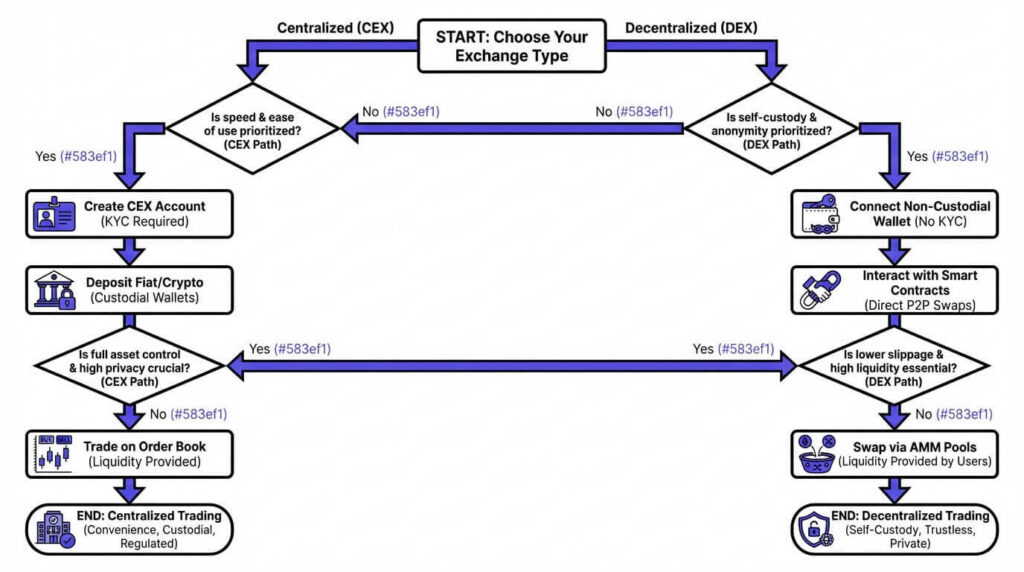
When to Use a CEX vs a DEX
Choosing between a centralized and decentralized exchange often depends on the user’s needs, technical proficiency, and trading goals. While both types of platforms serve as access points to the crypto economy, they differ in how they balance usability, control, and risk.
For new users, centralized exchanges often provide a more accessible entry point. The ability to deposit fiat currencies, reset lost credentials, and receive customer support reduces the complexity of early interactions with digital assets. CEXs are typically used when fast execution, deep liquidity, and access to a broad range of trading pairs are prioritized.
More experienced users, or those with a strong preference for self-custody and privacy, may choose decentralized exchanges. Since DEXs do not require identity verification, they allow for pseudonymous trading and full control of private keys. This is particularly relevant in regions with restricted access to financial infrastructure or where regulatory environments are uncertain.
DEXs also play a vital role in token discovery. Many new or experimental tokens are first available through decentralized liquidity pools before listing on major centralized platforms. This makes DEXs a preferred environment for early-stage traders and developers.
That said, many participants in the crypto ecosystem use both models depending on context. For instance, a user may purchase assets through a CEX for convenience, then move funds to a self-custodied wallet to interact with decentralized protocols. This hybrid approach is increasingly common as users seek both flexibility and control.
Strategic Considerations in Choosing a Crypto Exchange Model
Cryptocurrency exchanges, both centralized and decentralized, serve as critical infrastructure in the digital asset ecosystem. Rather than representing mutually exclusive paradigms, CEXs and DEXs increasingly coexist as part of a complementary trading strategy.
From a strategic standpoint, centralized exchanges remain the primary access point for fiat-to-crypto onboarding, offering deep liquidity, regulatory compliance, and structured support systems. This makes them particularly suited for institutional participants, high-frequency trading, and users prioritizing convenience and speed.
Decentralized exchanges, meanwhile, offer structural advantages aligned with the principles of financial sovereignty and protocol-level transparency. Their non-custodial architecture enables direct control over digital assets and provides broader token exposure, particularly for early-stage projects or unlisted assets. However, users must navigate risks associated with smart contracts, interface complexity, and a lack of formal support.
In practice, many participants adopt a hybrid strategy: acquiring assets on a CEX, transferring them to a self-custodied wallet, and interacting with DEX protocols for liquidity mining, yield farming, or accessing niche assets. This reflects a maturing user base that values both operational efficiency and decentralized control.
As regulatory frameworks evolve and hybrid platforms gain traction, the distinction between CEX and DEX is becoming less binary. Exchanges are beginning to integrate features from both models, aiming to offer compliant, non-custodial trading with enhanced UX. Future-ready users will likely rely on platforms that balance regulatory alignment with the ethos of decentralization.
Decision Matrix
| Strategic Priority | Exchange Type |
| Fiat access, high-volume trading | Centralized Exchange (CEX) |
| Self-custody, privacy, autonomy | Decentralized Exchange (DEX) |
| Token discovery, niche assets | Decentralized Exchange (DEX) |
| Customer support & recovery | Centralized Exchange (CEX) |
| Permissionless DeFi access | Decentralized Exchange (DEX) |
| KYC-compliant access | Centralized Exchange (CEX) |
FAQ
Is a CEX more secure than a DEX?
Each model carries its own set of risks. Centralized exchanges typically invest in advanced security infrastructure but present a single point of failure, making them attractive targets for hackers. Decentralized exchanges eliminate custodial risk but rely on smart contracts, which may contain bugs or vulnerabilities if unaudited. The concept of “security” depends on whether a user is more concerned about platform breaches or contract-level exploits.
Which type of exchange offers more privacy?
Decentralized exchanges generally allow users to trade without completing identity verification processes. This offers a higher degree of privacy compared to centralized platforms, which are usually obligated to collect personal data in compliance with regulatory standards. However, blockchain transactions on DEXs are public and traceable, so privacy is not absolute.
Can I use both CEX and DEX?
Yes. Many users operate across both platforms, depending on the use case. For example, one might purchase crypto through a CEX using fiat and then move those assets to a self-custodied wallet for use on a DEX. Using both types of exchanges allows users to balance convenience, control, and access to specific assets.
What is a DEX wallet?
A DEX wallet is a non-custodial wallet, such as MetaMask or Trust Wallet, that connects directly to decentralized protocols. These wallets allow users to manage their private keys and sign blockchain transactions, including token swaps, without involving a third party.
Is Binance a DEX or a CEX?
Binance is primarily a centralized exchange (CEX). However, it has also launched a decentralized trading platform called Binance DEX, which operates independently of the main exchange. Users should distinguish between the two, as they have different custody models, interfaces, and regulatory frameworks.
Can I Stake or Earn Yield on Both CEXs and DEXs?
Yes, but the mechanisms differ. CEXs offer staking and yield products as managed services, often with fixed rates and terms. DEXs support yield farming and liquidity provision directly through smart contracts, typically offering higher but more variable returns — along with greater risk.
What are the Risks of Using a DEX for the First Time?
First-time DEX users often face risks such as sending funds to the wrong address, interacting with malicious contracts, or overpaying for gas fees. There is also no customer support. Learning to use a non-custodial wallet and verifying smart contract integrity are critical steps before trading.
Can I Trade the Same Tokens on Both CEXs and DEXs?
Not always. While popular tokens like BTC and ETH are typically available on both, many new or experimental tokens are first launched on DEXs. CEXs often list assets only after legal, liquidity, and compliance checks, which can limit early access.