
How to Avoid Crypto Scams
5 March 2026 • 17 Min ReadWhat Are Crypto Scams?
Cryptocurrency scams are deceptive schemes that use the features of cryptocurrencies, such as their anonymity, lack of centralization, and ability to do transactions that can’t be undone, to steal money from people or businesses. These scams are different from regular financial fraud because they use digital wallets, blockchain transactions, and crypto exchanges, which makes it harder to find and get your money back.
Scammers can fool both new and experienced investors by making false promises, pretending to be someone else, or messing with technology. Cryptocurrencies work outside of established banks and other financial institutions, so victims usually don’t have many options after they’ve sent money.
Why Crypto Is a Popular Target for Scammers
Here are some of the reasons why scammers like cryptocurrencies:
- Lack of Regulation: A lot of crypto marketplaces are in places where there aren’t many rules or none at all.
- Anonymity and Pseudonymity: Even though blockchain transactions are public, wallet addresses often keep users’ real names secret.
- High Public Interest: The rapid rise in the popularity of cryptocurrencies draws in a lot of people who don’t know much about how they work or how to spot common scams.
Because of all the new technology and ways to make money, this is a great place for fraud to happen.
Key Differences Between Crypto Scams and Traditional Scams
| Feature | Traditional Scam | Crypto Scam |
| Payment Method | Bank transfers, credit cards | Cryptocurrency (Bitcoin, Ethereum) |
| Traceability | Easier to trace | Harder to trace due to decentralization |
| Legal Protections | Often available | Usually absent |
| Refund Possibility | Sometimes | Rare to impossible |
| Common Platforms | Phone, email, websites | Social media, exchanges, and wallet apps |
Crypto scams often get past regular fraud detection systems because they use people’s inexperience, the platform’s complexity, and the need to act quickly.

How to Tell If a Crypto Scam Is Happening
Most of the time, cryptocurrency scams don’t start with obvious technical attacks. They often start with small changes in behavior that play on how people think. You need to stop thinking about the scam itself and start thinking about the tricks used to get people to fall for it in order to read these early warning signs. This section talks about how scammers use communication and emotion to get people to do things without thinking about it, often before the victim knows what’s going on.
Signs that someone is trying to commit fraud
Getting a message, email, or call from someone you don’t know without having talked to them first is one of the most common warning signs. Most of the time, these messages are about a problem that seems urgent or an opportunity that seems too good to pass up. Scammers know that when people are under a lot of stress, they are more likely to do things that don’t make sense. To get people to act quickly, they offer deals that are only available for a short time, say that accounts have been hacked, or say that money is at risk unless action is taken right away.
Another sign that something is wrong is when someone promises guaranteed returns, which are often hidden behind “exclusive” investment options. No real investment can give you that level of confidence in the world of crypto, which is always changing. You should be wary right away if returns sound like they are guaranteed, quick, and safe.
Scammers also depend on keeping things secret. People who have been hurt are often told not to talk to anyone else about the problem, either directly or in a way that isn’t obvious. This way of separating people makes it impossible to check facts and gives the impression that there is an urgent need for privacy, all of which are meant to make it harder to make good choices.
Emotional and Cognitive Manipulation
These strategies might seem complicated at first, but they work best because they play on people’s emotional weaknesses. People are skillfully made to ignore their own judgment by using fear, excitement, and trust.
For example, you might get a fake message saying that your wallet has been hacked and telling you to check it “urgently.” In other cases, you might be told that you are eligible for a special investment opportunity or giveaway that is only available for a short time. These stories aren’t just random. They are meant to keep you from doing due diligence.
Trust is another important part. To get people to trust them, messages sometimes look and sound like they come from well-known people or businesses. Even though these attempts don’t always involve full impersonation, they use familiarity and perceived authority to lower your guard.
In the end, you should be very careful in any situation that tries to control how quickly you make a decision, limit how much other input you can get, or make you feel like you have to act right away. Scammers don’t win because they are smarter than other people; they win because they outpace their ability to think critically in the moment.
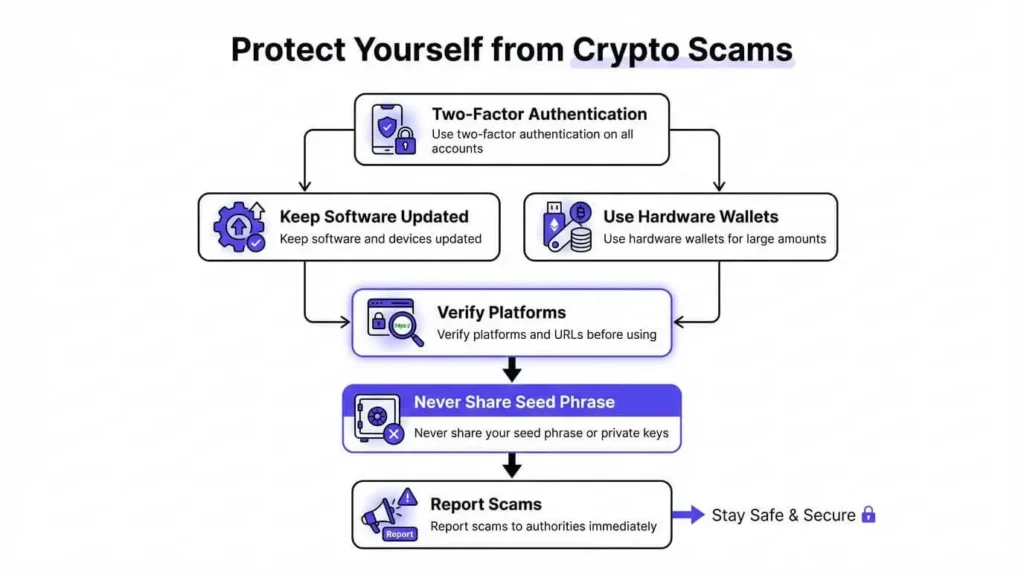
How to Protect Yourself from Being Scammed with Cryptocurrency
How to Improve Your Digital Security
The first step in keeping yourself safe from cryptocurrency scams is to practice good digital hygiene. This means that you should protect all of your accounts by using complex, unique passwords and two-factor authentication (2FA). To make devices safer, they should always have the latest software versions installed. Don’t download apps, browser extensions, or pirated software that you don’t know are safe. These are common ways for malware and spyware to get into crypto wallets.
A hardware wallet, also known as cold storage, is the best way to keep significant amounts of cryptocurrency safe. Cold wallets, unlike hot wallets, keep assets offline, which makes them less likely to be hacked. On the other hand, hot wallets are linked to the internet.
Recognizing Safe Platforms
One important way to lower risk is to use platforms that you can trust. Most of the time, people trust exchanges and wallet providers that are registered with financial supervision agencies and keep excellent records of how they do business. They will be very honest about their security measures, management teams, and connections to regulators. When you get to a site through social media or search engines, it’s very important to check the official domains. This is because some phishing schemes use fake websites that look like real ones.
Users should save official URLs as bookmarks and not click on login pages that come from emails, texts, or ads that they didn’t ask for. If you’re still not sure, you can feel better by looking up platform information on public aggregators like CoinMarketCap or CoinGecko.
How to Handle Seed Phrases and Private Keys
The seed phrase, also known as a recovery phrase or mnemonic phrase, is the most important thing to keep your digital currency safe. It gives full access to the wallet that comes with it, which means it also gives access to the funds that it holds. It needs to be protected like financial information or sensitive paperwork because of this.
You should never tell anyone this phrase, no matter what the reason or the situation. No real wallet provider, exchange, or support person will ever ask for it. Even if you don’t mean to, sharing it puts the whole wallet in danger.
The safest way to save a seed phrase is to do it offline. Writing it down and putting it in a safe, fireproof place is the best thing to do. On the other hand, storing it in emails, screenshots, cloud storage, or any device that is connected to the internet makes it even more dangerous. You can’t get back in if you lose access to your wallet without the seed phrase. This means that managing safety is not only important, but also necessary.
Critical Thinking and Verification
Scammers rely on speed and distraction. If you take the time to look at a website, make sure a contact is who they say they are, or look into an investment opportunity, you can avoid losing money that you can’t get back. People don’t usually feel like they have to do something right away when they get an official message.
Before you do anything with the funds, it’s a good idea to look into the project’s leaders, read its history, and read any technical papers (like a white paper). People’s comments on trustworthy forums and watchdog sites can also show patterns of fraud or strange behavior.
What to Do If You Get Scammed
No matter how hard they try, even careful people can fall for cryptocurrency scams. It is hard to recover cryptocurrency from blockchain because it is decentralized, but acting quickly and with knowledge can limit future harm, help with investigations, and keep other people from having the same problems.
Immediate Steps to Take
Get any funds that are still available as soon as possible. If the scam involved a hacked wallet or account, move the money to a safe wallet that isn’t connected to the scam. Change all of your passwords, especially those that are linked to email accounts, exchanges, or mobile devices.
Next, write down everything that happens. Keep any screenshots, emails, wallet addresses, and transaction IDs that have to do with the event. If you decide to file a formal complaint with the police or a financial platform, this proof will be very helpful.
You should also let your cryptocurrency wallet provider or exchange know. Most crypto transactions can’t be undone, but if you send in the report quickly, some platforms might be able to freeze assets or flag accounts that look suspicious.
Where to Report Crypto Scams
In the United States and other places, a number of agencies will take complaints about cryptocurrency fraud. Victims should report the incident to:
- The Federal Trade Commission (FTC) via reportfraud.ftc.gov
- The Internet Crime Complaint Center (IC3) operated by the FBI at ic3.gov
- The Securities and Exchange Commission (SEC) for investment-related fraud at sec.gov/tcr
- The Commodity Futures Trading Commission (CFTC) via cftc.gov/complaint
Victims can also interact with cybersecurity groups that keep blacklists or warning systems for crypto users about fake wallet addresses or phishing sites.
Reporting fraud not only helps with investigations, but it also helps regulators understand how wrongdoing happens on different platforms.
Considering the legal and tax effects
Some losses from bitcoin fraud may be eligible for different kinds of tax relief, depending on where you live and what kind of loss it is. You should talk to a tax expert to see if you can claim a loss and how to do it.
Some victims may also file civil lawsuits, but these are usually not successful because it is hard to find and identify the criminals in anonymous blockchain transactions.
Psychological and Community Support
It can be very upsetting to get scammed. A lot of the time, people are too embarrassed or angry to ask for help. But being honest about the problem and telling others about it can help them stay out of the same situation.
Joining trustworthy crypto communities, advocacy groups, or consumer protection groups can also help and keep you up to date on the latest issues.
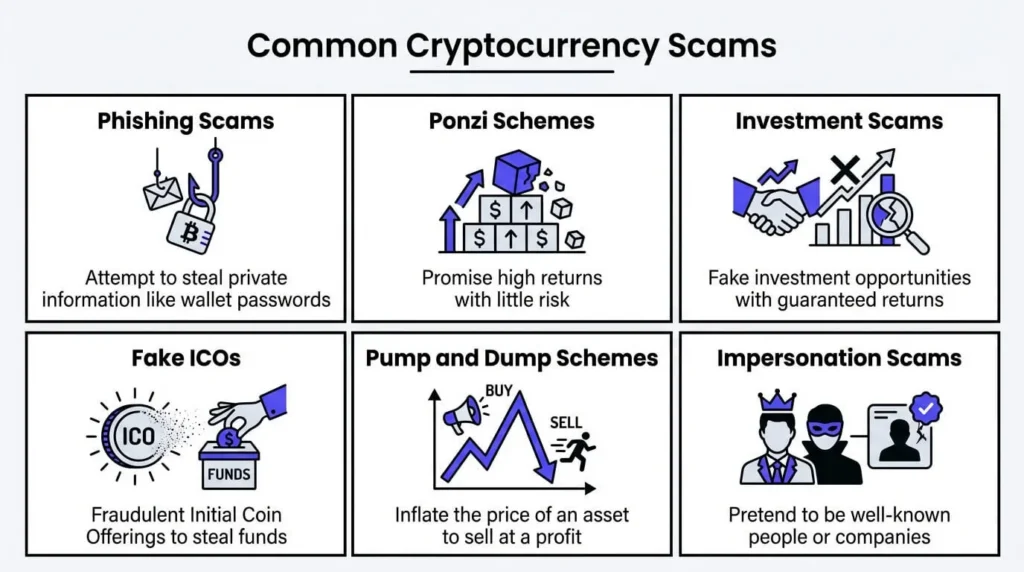
Common Types of Cryptocurrency Scams
There are many different kinds of cryptocurrency scams, and they change all the time as new technologies and market trends come out. Most scams fall into certain groups, even though the ways they are carried out may be different. You need to know how these scams work in order to avoid them.
Phishing Scams
Phishing scams try to get people to give up private information, like the passwords to their wallets. Attackers may set up fake exchanges or wallets that look like real ones and trick people into giving them their login information. Some people use email, chat apps, or social media to act like customer service. The goal is to get into wallets and move money without permission.
Investment and Ponzi Schemes
These scams promise returns that are much higher than normal with little to no risk. Most of the time, the plans depend on paying people who join early with money from new recruits. In most places, this is not a legal way to make money. People who promote scams may say they have inside information or use fake success stories and testimonials to get people to fall for them.
Impersonation Scams
Scammers often act like famous people, crypto influencers, CEOs, or people who work for companies that people trust. They might create fake social media profiles or use fake screenshots to make themselves look real. People who have been scammed are often told to send cryptocurrencies with the promise of getting more back or to take advantage of an “exclusive” investment chance.
Rug Pulls and Exit Scams
A rug pull happens when the people who started a project suddenly stop working on it or take all the money they raised from investors. These scams happen a lot in decentralized finance (DeFi) and usually involve fake coins, fake whitepapers, and aggressive advertising. When people put money into the project, it shuts down, and most of the time, there is no way to find out who did it.
Airdrop and Giveaway Scams
Fake giveaways often promise people free cryptocurrency if they first send a small amount of money to a specific wallet. In real life, there is no return. Legitimate airdrops never ask users for money, private keys, or access to their wallets. These scams usually work by making people feel like they need to act fast, and they are spread through fake or hacked social media accounts.
Fake ICOs (Initial Coin Offerings)
Scammers might set up fake ICOs that look like real cryptocurrency fundraising campaigns. People are asked to put money into a project that seems like it will be successful, but once the money is collected, the developers vanish. These plans often include professionally designed websites and whitepapers, but they don’t have any technical information or team members that you can recognize.
Malware and Remote Access Tools
Some hackers use malware to gain access to a user’s device without their knowledge. This includes keyloggers, clipboard hijackers, and programs that look for wallet files. Some people tell victims to install remote desktop software while pretending to help them with tech problems. Once someone has access, they can take money right out of the wallet or exchange.
Romance and Social Engineering Scams
Most of the time, romance scams start on dating sites or social media. After they have gained your trust, the scammer will either ask for money for something important or offer you an investment opportunity related to digital currencies. These scams prey on people’s emotional weakness and can last for weeks or even months before they ask for money.
Fake Job Offers and Employment Scams
Fake job offers may be sent to people who work as crypto traders, exchange affiliates, or payment processors. Victims are often asked to pay fees or send bitcoin ahead of time as part of the “onboarding” process. In some cases, fake checks are sent to victims, who are then told to use that money to buy bitcoin. However, the checks turn out to be fake.
Blackmail and Extortion
Scammers often say they have sensitive information or hacked data and ask for cryptocurrencies to keep it from getting out. Most of the time, people send the texts to big groups and don’t include any specific information. A lot of them are just empty threats, but some of them might have stolen data from other breaches that have nothing to do with the threat. Experts say you shouldn’t pay and should instead report the cybercrime to the authorities.
Legal and Regulatory Considerations
The law is still trying to figure out how to handle scams involving the virtual currency. It is hard for national and international regulators to protect people and go after fraud because blockchain technology is decentralized and has no borders. Still, legal systems are starting to come together, which gives people both ways to protect themselves and ways to get help.
Regulatory Authorities and Jurisdiction
In numerous jurisdictions, different government agencies watch over various aspects of cryptocurrency activity. In the United States, the Securities and Exchange Commission (SEC), the Commodity Futures Trading Commission (CFTC), and the Financial Crimes Enforcement Network (FinCEN) all perform distinct tasks. These jobs depend on whether the asset is a commodity, a security, or subject to laws against money laundering.
Countries have done things in various manners. For instance, the European Union’s Markets in Crypto-Assets Regulation (MiCA) attempts to ensure that all member states follow the same rules. Japan, Singapore, and Switzerland have also made rules for licensing bitcoin exchanges and custodians at the same time.
Even with these changes, enforcement is often hindered because many transactions are anonymous, privacy coins are used, and offshore platforms are common.
Classification of Crypto Assets
The way a cryptocurrency is classified can have a big impact on how well it is protected by the law. Some countries see crypto tokens as securities, which means they have to follow the rules for registration and disclosure in those countries. Some people might think of them as digital property, ways to pay, or even goods.
This lack of clarity can make it harder for investors to protect themselves and for authorities to go after fraudsters. For example, if an asset is not legally defined as a security, some rules that protect consumers may not apply to it.
Consumer Protections and Limitations
Two examples of traditional financial protections that don’t usually apply to cryptocurrency transactions are deposit insurance and chargeback rights. You can’t change a transaction once it’s been sent out and confirmed on the blockchain. This means that it is up to each participant to keep their private keys safe and make sure that the people they are dealing with are who they say they are.
Some exchanges and wallet providers have created their own fraud departments and ways to settle disputes, but these are not required and don’t always work well. In some cases of fraud, you may be able to get legal help, but you usually have to find the person who did it, which can be hard or impossible if you can’t issue a subpoena or work with other countries.
Issues with Prosecution and Enforcement
Law enforcement is paying more and more attention to big cryptocurrency schemes, especially those that involve money laundering, investment fraud, and unregistered securities. You need clear proof, the right jurisdiction, and the right technical tools to win a case, though.
It’s still hard to work together across borders. Scammers usually work in countries that don’t have treaties that let them send criminals back to their home countries or official ways to deal with cybercrime. The rise of anonymizing technologies and decentralized platforms has also made digital forensics and asset recovery more difficult.
Emerging Legal Trends
As scams get more complicated, lawmakers and regulators are coming up with new ways to keep an eye on them and stop them. Here are some of them:
- Mandatory Know Your Customer (KYC) and Anti-Money Laundering (AML) compliance for exchanges and service providers
- Licensing requirements for crypto custodians and platforms
- Greater transparency around initial coin offerings (ICOs) and tokenized assets
- The development of centralized reporting systems for fraud
Some jurisdictions are also exploring victim compensation funds or insurance mechanisms, though such initiatives remain in early stages.
FAQ
Can I get my cryptocurrency transactions back if I was scammed?
No. After a transaction is confirmed on the blockchain, it is added to a ledger that cannot be changed or undone. This is true for both real and fake transfers. Centralized platforms may be able to help in very rare cases if they are told right away, but there is no official way to cancel transactions.
How can I tell if a crypto platform is regulated?
Check to see if the platform is licensed or registered with a national financial organization. Many good websites have their license numbers and the jurisdictions where they can do business in the footer. You can find out more about this by looking at official government databases or directories of independent regulators. Be careful if there is no mention of a license at all.
Are all unsolicited crypto investment offers scams?
Not every offer is a scam, but you should be careful if someone you don’t know tries to get you to invest without asking. This is how most scams begin. Don’t do it if you didn’t ask for it. That’s a good rule of thumb. Take some time to learn more about it and get other people’s opinions before you get involved.
Are crypto giveaways on social media legitimate?
There are real giveaways, but you never have to pay to enter. Scammers often use the format to make fake endorsements or copy profiles. Don’t just believe what you read in a post. Always check the company’s official website or a verified social media account for free stuff.
Can I report a crypto scam if I live outside the U.S.?
Yes. Most governments have teams that deal with cybercrime or financial watchdogs that look into fraud involving cryptocurrencies. You can also report cases to websites like Chainabuse.com or international groups like INTERPOL and Europol. Reporting helps make people more aware of the law and enforce it around the world, even if the money can’t be found.
How do I secure my wallet against remote access attacks?
Use hardware (cold) wallets to store your coins for a long time, and make sure that two-factor authentication is turned on for all of your exchange accounts. Don’t install software or browser add-ons that you don’t know about. You should never type your recovery phrase into a device that is connected to the internet unless you are restoring a wallet from a trusted app. Always keep it off the internet.