
Staking vs Mining: A Complete Guide to Crypto Participation
17 March 2026 • 24 Min ReadIf you want to do more with cryptocurrencies than just buy and hold them, staking and mining are two options that keep coming up. Both enable you add to a blockchain network and get paid for it, but they are very different in how they work, what they need, and what risks they pose.
InstaXchange’s article explains all you need to know about staking and mining, including how each method works behind the scenes, what the practical expenses and returns are, and which way would be best for your goals, budget, and level of comfort. No need to know anything about technology before. Let’s get started.
What is mining for cryptocurrency?
Crypto mining is what keeps proof-of-work (PoW) blockchains, like Bitcoin, running safely. Miners verify transactions and record them on the blockchain. The main point is that there is no bank or company in the middle that has to approve transactions. Instead, PoW networks depend on miners who give the network their computational power. In return, they get new coins and a cut of the transaction fees. Both the network and the miners are delighted with this deal.
What began as a hobby for tech-savvy people on their laptops has grown into a full-fledged enterprise. To make money mining nowadays, you usually need access to inexpensive energy, specialized hardware called ASICs, and the ability to expand your business. The threshold is high, but mining is still a key part of blockchain decentralization, and anyone who wants to compare staking versus mining has to know how it works.
How Does Crypto Mining Work?
When it comes to technology, crypto mining is a race. Miners race to solve a cryptographic challenge, check a group of transactions, and suggest the next block to be put to the chain. This is how each part fits together.
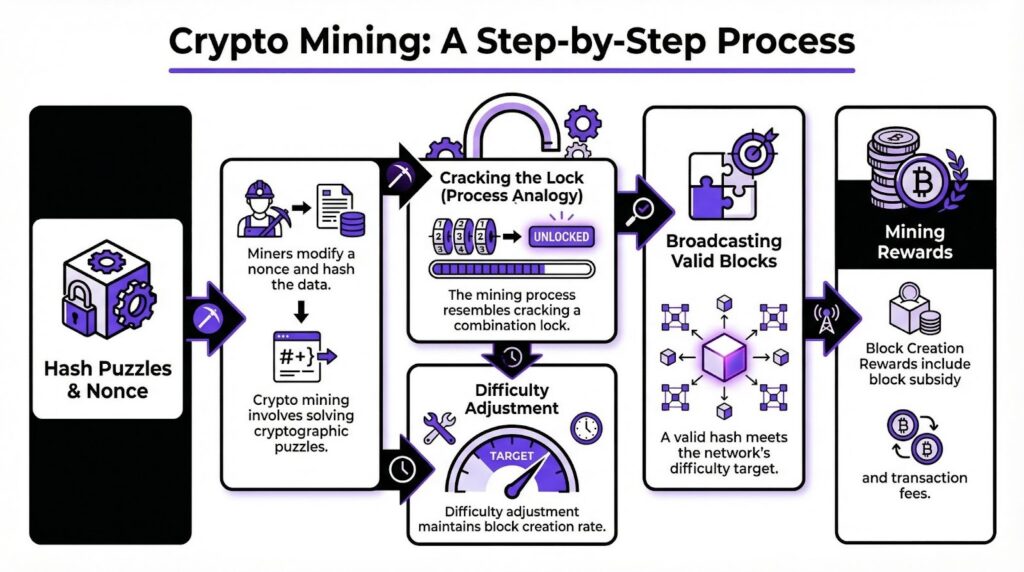
Hash Puzzles and Nonce Guessing
Before a new block can join the blockchain, it must to solve a math problem. Miners get around this by changing a little number called a nonce, which stands for “number used once,” in the block’s data and then running everything through a cryptographic hash function (Bitcoin uses SHA-256).
What is the goal? Create a hash output that is lower than a certain target established by the network. Miners can’t locate the right nonce any faster than they can guess, check, and guess again—billions of times a second. The more powerful your gear, the more estimates you can make and the better your chances of hitting the target first.
Block Creation and Miner Rewards
When a miner finds a legitimate hash, they tell the rest of the network that the block is done. Other nodes rapidly check the work, and if everything is correct, the block is added to the chain for good.
The miner who wins gets two kinds of payment: a block subsidy, which is new coins made by the protocol, and the fees for every transaction that is included in that block. The block subsidy on Bitcoin is cut in half around every four years. The crypto community calls this event “the halving.” This slow drop in the number of new coins is a key feature of Bitcoin’s deflationary nature.
Mining Analogy: Cracking a Combination Lock
Imagine a huge combination lock that no one knows how to open. You can only open it by trying different combinations as quickly as you can. Now picture many people all turning the dial at once. The lock resets with a new combination, initiating a new race. The first participant to decipher the code is rewarded with a gift.
That’s mining in a nutshell: fast guessing powered by a lot of computational power. The faster your hardware, the more combinations you can try, and the higher your chances.
Difficulty Adjustment and Immutability
If a lot of miners got faster all at once, as when a lot of new hardware comes out, blocks would start showing up too quickly. The network automatically changes the complexity of the puzzle up or down to keep things stable (roughly one new Bitcoin block every 10 minutes). More miners are joining? Puzzles that are harder. Miners drop off? Puzzles that are easier. The system fixes itself.
This approach also makes the blockchain even more secure. A hash of the block before it is stored in every block. If you changed an old block, you would have to solve the puzzle for that block and every block that came after it again, and you would have to do it faster than all the honest miners on the network. That is basically impossible on a chain as big as Bitcoin.
Mining Rewards vs Risks: What You Should Know
Mining can make you money, but it’s not a sure way to make money. There are pros and cons to every business. Here is a fair look at both sides of the ledger.
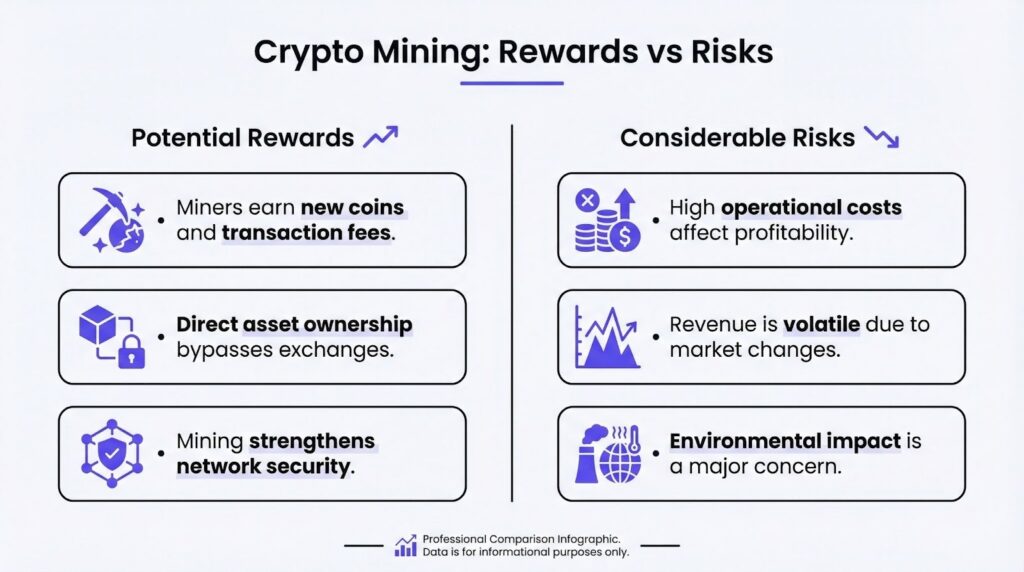
Potential Rewards of Mining
Earning New Coins
When you mine a valid block, you get new cryptocurrency in your wallet, as well as the transaction fees that were included in that block. The halving schedule on Bitcoin slowly lowers the number of new coins issued. This has historically led to higher prices over time, which has rewarded miners who got in early and stayed.
Direct Asset Ownership
Mining is a way to get crypto without having to buy it on an exchange. You get coins directly from the protocol, which means you own them from the time they are made. That’s a big plus for folks who value their freedom and want to avoid middlemen.
Making the Network Stronger
Miners don’t just get paid; they also do important work. They make the blockchain harder to attack and more reliable for everyone by checking transactions and adding blocks. The network gets stronger and less centralized as more miners join.
Upside During Bull Markets
When the price of crypto goes up, the value of the coins you’ve previously mined can go up a lot. If your running costs (rent, power, and maintenance) stay about the same, higher pricing mean bigger profit margins. During these periods, miners with lean, well-designed setups and access to inexpensive electricity tend to do the best.
Risks and Drawbacks to Consider
High Capital and Operational Expenses
It costs a lot to get started. ASIC machines and high-end GPU arrays that are good for mining can cost thousands of dollars. You’ll also need enough cooling, a strong internet connection, and a place to put everything. Then there’s the electricity bill, which is the biggest ongoing cost for many miners.
Revenue Volatility
The price of mining changes all the time, which affects your income. Your margins can drop overnight if the price of coins drops, the network difficulty increases, or the global hash rate rises. Mining income is always uncertain, and even well-run businesses often have periods where they break even or lose money.
Rapid Hardware Obsolescence
Mining hardware wears out quickly. A top-of-the-line ASIC now might not be the best one in a year or two when a newer, more efficient model comes out. To be competitive, you typically have to buy new equipment on a regular basis, which might cut into your overall profits.
Environmental Impact
Mining on a large scale uses a lot of energy. The carbon impact is enormous if fossil fuels generate that power. Environmental groups and authorities have also spoken out against this, and it’s one of the main reasons the industry is moving toward cleaner energy sources.
Legal and Regulatory Uncertainty
Mining rules are very different from one country to the next, and sometimes even from one state or province to the next. Some places have completely banned mining, while others have made it very expensive for industrial miners to use electricity. The way taxes are handled is also inconsistent. A sudden change in policy in your area might turn a prosperous business upside down.
What Is Crypto Staking?
Crypto staking is the proof-of-stake (PoS) way to mine. You don’t just throw processing power at math problems; you also lock up some of your Bitcoin as collateral to help the network confirm transactions and make new blocks. You might think of it as putting a security deposit on the line: you show that you care about the network’s success and get benefits for following the rules.
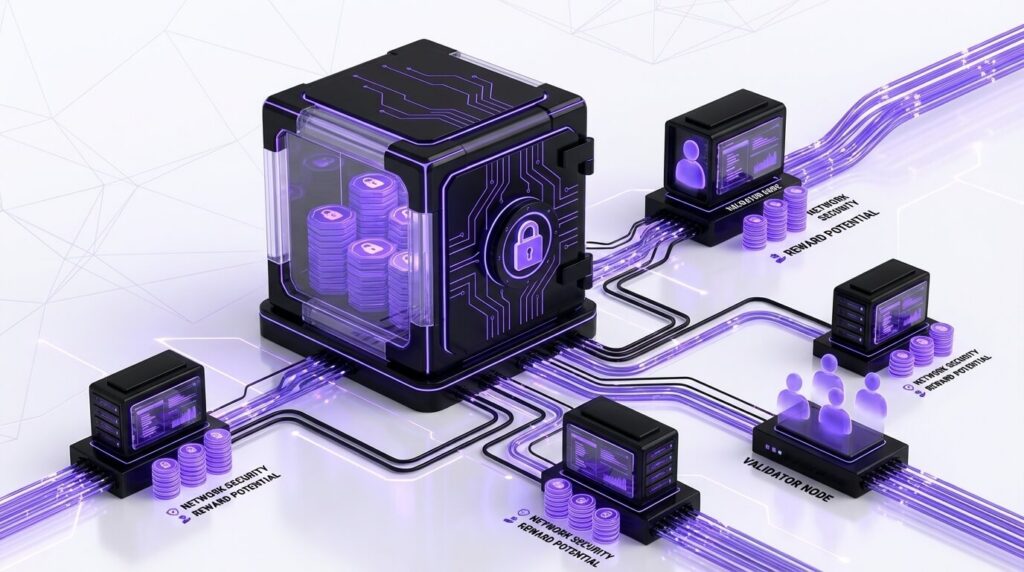
Validators are the people who suggest and confirm blocks. They are chosen based on how much crypto they have staked, but sometimes other things like randomness or how long they have been staking are also taken into account. Honest validators get a consistent stream of block rewards and transaction fees. Validators who try to cheat? They lose part of their stake, which is a punishment called “slashing.”
It’s okay if not everyone wants to run a validator node. Most PoS networks let normal users give their tokens to a validator they trust. Delegators get a share of the rewards in exchange for not having to handle any infrastructure. One reason staking has been so popular is that this delegation model makes it easy to do, doesn’t use a lot of energy, and doesn’t need any specific hardware.
How Does Staking Work?
At its most basic level, staking implies putting a certain number of tokens into blockchain technology. Those tokens are your collateral, or your “skin in the game.” The size of your stake affects how often you’re chosen to validate transactions, which in turn affects how much you make.
In any staking system, there are two main roles: validators, who execute the labor of verifying blocks, and delegators, who give their tokens to a validator and share in the profits.
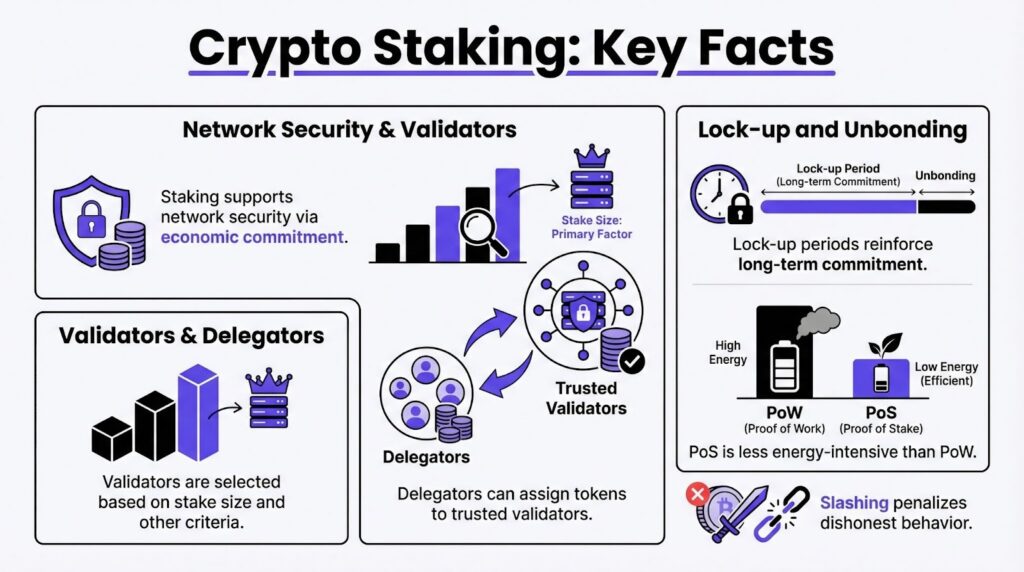
Validator Roles and Delegation
Validators do most of the work on a PoS blockchain. They are picked to propose and check new blocks, and the number of tokens they have staked normally determines who gets to do this. However, other protocols mix in randomness or look at how long the tokens have been locked. Validators need to keep the infrastructure secure and the uptime stable in order for things to run properly.
If running a validator node sounds like too much work for you, delegating is the easier option. You give your tokens to a validator you trust, and that validator handles the technical aspect. The validator takes a small cut of the earnings and gives you the remainder. It’s a win-win: validators get a bigger stake, which makes it more likely that they will be chosen, while delegators get benefits without having to do anything with a server.
This system makes it much easier for more people to take part. You don’t have to be a software developer or own a data center. Just pick a trusted validator, give them your tokens, and let the blockchain do the rest.
Lock-Up Periods and Unbonding
When you stake tokens, they usually stay locked up for a certain amount of time. You can’t trade, move, or spend them during that time. This lock-up isn’t random; it stops short-term speculation and keeps the network stable by making sure that validators are really committed for the long run.
You will experience a “unbonding period” if you elect to take your tokens out. This cooling can last anywhere from a few days to a few weeks, depending on the blockchain. Your tokens will only be liquid again after the unbonding process is finished.
It’s apparent what you’re giving up: some freedom in return for regular, predictable rewards. That’s frequently a really good offer for people who plan to keep their crypto regardless.
Penalties and Slashing
Slashing is the technique that PoS networks make sure that validators are honest. If a validator defies the rules by signing two blocks that don’t agree, remaining offline for too long, or doing something bad, the protocol automatically takes away some of their staked funds. Sometimes, delegators who supported that validator also lose some of their tokens.
Double-signing (validating blocks that are different from each other), lengthy downtime, and any other conduct that goes against the network’s agreement are all common slashing violations.
What do delegators need to know? Don’t only choose the validator that offers the most prizes. Check out their uptime history, how their infrastructure is set up, and what others in the community say about them. A little bit of research can save you money that you don’t have to spend.
What Is Proof-of-Stake (PoS)?
Proof-of-Stake is the way that everyone agrees on what to do with staking. Proof-of-Work urges miners to use electricity to solve problems, while PoS asks people to put their own money on the line. You put up cryptocurrency as collateral, and in return, you have the power to check transactions and suggest new blocks.
PoS does something amazing: it protects the network with a minuscule fraction of the energy that PoW needs, and it also makes it easier for more individuals to help keep the blockchain honest.
PoS Mechanics
In a PoS blockchain, the protocol selects validators to create new blocks based primarily on the size of their stake. Some chains also factor in staking duration or introduce randomness to keep things fair. Once selected, a validator assembles a block of pending transactions and proposes it to the network. If other validators confirm it’s valid, the proposer collects rewards—typically a mix of newly created tokens and transaction fees.
People are purposely given economic reasons to be honest. People who try to cheat the system risk having their stake cut, which means they lose actual money. This is what makes PoS safe: self-interest and network health are in sync.
PoS Variations
Different blockchains have put their own spin on PoS, but the basic idea is still the same: stake tokens, validate blocks, and get rewards.
- With Delegated Proof-of-Stake (DPoS), token holders can vote for a limited group of delegates to check the validity of blocks. This is how networks like EOS and Tron work. Some people say it’s too fast and gives too much power to too few people.
- Polkadot uses Nominated Proof-of-Stake (NPoS), which enables users choose validators they trust. The protocol then picks the best validators from those nominations, taking into account both efficiency and decentralization.
- Hybrid models combine PoS with additional systems, such as Proof-of-Authority or reputation score, to improve performance or governance.
These differences highlight how adaptable the PoS idea can be, as it changes to fit the needs of each ecosystem.
Efficiency and Sustainability
Energy efficiency is probably the best thing about PoS. Validators don’t need warehouses full of ASICs that take a lot of electricity. They have lightweight servers that use less electricity instead of more. The difference in the environment is huge compared to PoW mining.
This lean model also lets more people get involved. To validate transactions, you don’t need a lot of money or a warehouse lease. A simple server and a stable internet connection will do. The conversion from PoW to PoS on Ethereum was a big deal, and the need for energy-efficient consensus has only grown since then. More and more modern blockchains are using PoS (or a version of it) as their base. This is in line with both environmental concerns and the requirement for scalability.
What You Need to Know About the Pros and Cons of Staking
Staking is a very different feeling from mining. The boundaries are lower, the process is easier, and the work that needs to be done is little. But “lower barrier” doesn’t mean “no risk.” Let’s take a fair look at both sides.
Benefits of Staking
Accessibility
You don’t need a lot of tools to stake. With just a few taps, most people can start from a wallet app, an exchange, or a dedicated staking platform. Because it’s so simple, staking is the best way for new users and people who aren’t tech-savvy to get started.
Energy Efficiency
Staking utilizes a lot less electricity than mining because it doesn’t need a lot of computing power. Staking is the better alternative whether you care about the environment or just want to keep your electricity cost normal.
Passive Income Opportunities
When you lock up your tokens, they start to earn rewards. Returns may come on a set schedule or change based on how busy the network is, but either way, you’re making money without having to do anything. It’s one of the closest things bitcoin has to an income stream that you can “set it and forget it.”
Broader Decentralization
Delegation lets you help keep the network safe without having to run a node yourself. When millions of regular users delegate their tokens, it gives more validators power, which makes the network more decentralized and harder to control.
Drawbacks and Risks of Staking
Token Lock-Up
Once you stake your tokens, you can’t use them for a while. You can’t sell them when the price goes up quickly, and you can’t get to them in an emergency. That illiquidity might be painful if the market changes suddenly.
Price Volatility
You get tokens, not cash, as your staking compensation. If the price of the token declines by 30% while you are staked, the value of your rewards in fiat money also drops. You can potentially earn rewards in a long bear market and still have less buying power than when you started.
Validator Risk
When you delegate, you give someone else the technical tasks and trust them to do them. If the validator you choose gets sliced because they went offline, double-signed a block, or did something bad, you could lose some of your staked cash too. It’s not optional to check out your validator; it’s necessary.
Protocol Complexity
Staking is easier than mining, but it’s not easy. You still need to know about slashing conditions, unbonding deadlines, prize distribution timetables, and sometimes how government works. If you don’t do your homework, you can miss out on benefits or get bad news.
A direct comparison of staking and mining
It’s easy to see the differences between staking and mining when you put them next to each other. Let’s go over the most important parts.
Security and Consensus Mechanism
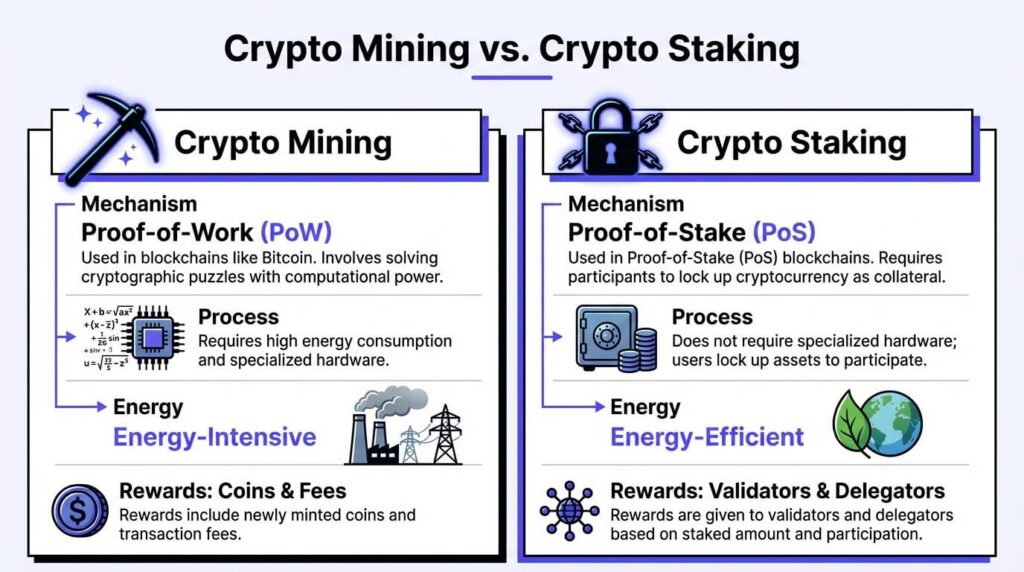
Mining makes a blockchain safe by making it hard to compute. Attacking the network is too expensive because it costs so much in hardware and electricity to solve those hash puzzles. This model has been demonstrated by Bitcoin for more than ten years.
Staking secures a blockchain by putting money on the line. Slashing means that validators who act badly lose real money. Both systems have the same main goal: to keep the ledger honest and safe from tampering. However, they get there in very different ways. One is powered by machinery and energy, while the other is powered by money and economic incentives.
Energy Consumption
This one is not close. Mining uses a lot of energy. Industrial-scale operations use thousands of equipment all day and night, and the amount of carbon they put into the air depends a lot on where the power comes from.
Staking, on the other hand, runs on regular servers that use a lot less power. This is generally the decisive factor for people who care about the environment.
Hardware Requirements
Mining needs special tools, including ASICs for Bitcoin and high-end GPUs for other chains. It also needs cooling systems, backup power, and room to work. The cost of the gear alone might be tens of thousands of dollars.
Staking doesn’t need much in comparison. Validators run small servers. All a delegator needs is a wallet and some tokens. For most people, the hardware question alone makes staking more appealing.
Setup and Maintenance
A mining operation needs constant care, like checking temperatures, updating firmware, repairing damaged parts, and fixing network problems. It’s work that requires your hands and never stops.
Staking, especially delegation, is almost hands-off. Validators need to keep their nodes up and up to date, but they don’t have to watch over any actual hardware. Delegators can check in every now and then to see how well the validators are doing and what benefits they are getting. Then they can go about their day.
Accessibility
Mining is mostly done by companies who have a lot of money, cheap power, and technical know-how. In a place where electricity is cheap, a warehouse full of ASICs is too much for the typical person to handle.
Anyone who has the necessary tokens can stake. You can take part whether you bet five tokens or five thousand. One reason PoS networks tend to have a wider range of members from all over the world is that they are open to everyone.
Predictable Rewards
The amount of money you get from mining changes based on network difficulty, the global hash rate, and coin pricing. A month might be great, then disastrous, and predicting returns is more of an art than a science.
Staking payouts tend to be more stable. Many protocols make it apparent how rewards are linked to the size of the stake and the performance of the validator. Prices of tokens still change, of course, but the yield in tokens is much more stable than the output from mining.
Potential for Profit: Long-Term Gains from Staking or Mining?
Mining and staking can both make money, but they do so in very different ways.
In the best conditions, mining has the greater ceiling. If you can get inexpensive electricity, high-quality gear, and a market that is growing, you can make a lot of money. The problem is that it’s hard to keep those perfect conditions. Equipment breaks down, energy prices go up and down, and crypto markets are known for being quite unstable. Mining is a risky, high-reward, and high-effort business.
Staking makes things go more smoothly. Returns are usually smaller in percentage terms, but they are more stable and don’t need as much labor to keep continuing. Staking is the best option for people who want to make money consistently and without having to take care of physical infrastructure.
Delegating your staking is typically the best way to get started, especially for beginners. You learn how PoS networks work, you get incentives from the start, and you don’t have to spend thousands of dollars on gear that you might not completely understand yet. You can mine later, when you have the knowledge and money to do it well.
Crypto for Beginners: Picking Between Mining and Staking
When you’re new to crypto, it can be hard to choose from all the different possibilities. Both mining and staking are real ways to join blockchain networks and get rewards, but they are very different in terms of how hard they are.
Mining requires a lot from you up front. You will need to do some study and buy particular gear, build a rig (or join a mining pool), keep an eye on performance around the clock, and manage heat output and power usage. That’s a hard on-ramp for someone who is still learning the basics of cryptocurrencies.
Staking doesn’t ask very much. Choose a token that lets you stake, a trustworthy validator, and a wallet or platform to delegate your tokens to. Then you may start making money. Many staking interfaces are made with beginners in mind. They walk you through the setup process and explain what your tokens are doing in simple terms.
From a risk point of view, staking is also more forgiving. There is no physical equipment that can break, overheat, or become useless. With with knowledge and patience, you can handle the biggest dangers, such price swings and cuts.
For most beginners, staking is the easiest way to get started because it costs less, is easier to set up, and has a gentler learning curve. Once you have more confidence, money, and technical knowledge, mining might be something you want to do. But staking is where most new people should start.
Important Things to Think About Before Choosing
Take a step back and think about your own situation before you decide to mine or stake. What is “right” for you depends on things that are only true for you.
How much risk you can take
When you mine, you have to deal with hardware failures, changes in electricity costs, and market volatility all at once. A business that is making money might quickly stop making money if prices drop or difficulty rises. There are dangers with staking, like slashing, validator downtime, and protocol issues, although the risks are usually less severe and more predictable. Staking is usually the preferable choice if you sleep better when things are less complicated.
Knowledge of Technology
To run a mining rig, you need to know about hardware specs, how to keep it cool, how to update the firmware, and how to set up the network. It’s engineering with your hands. Most people can figure out how to stake through delegation in just one afternoon, though. If you don’t want to deal with hardware issues, staking takes care of everything for you.
Upfront Capital
It can take thousands, perhaps tens of thousands, of dollars to put up a mining operation that can compete before it makes a single coin. All you need to stake is the tokens and a wallet that works with them. If you don’t have a lot of money to spend, staking helps you get involved right away without having to spend a lot of money.
Time Availability
Mining is not something you do without thinking. You need to keep an eye on the equipment, check the cooling systems, and update the software. Staking, especially delegation, is almost passive. You could check your rewards every few days, look at how well your validator is doing once a month, and then go about your life. If you don’t have a lot of time, staking is much more respectful of your schedule than mining is.
Regulatory Environment
Some places have made it illegal or hard to mine crypto, added special energy tariffs, or made it necessary to get a license. Staking is usually less regulated, but the rules about custody, taxes, and staking services differ from one place to another. Do some study on the laws in your area before you choose one of these options. One hour of homework now can help you avoid costly surprises later.
Long-Term vs Short-Term Goals
Mining could be a good fit for you if you’re looking for high-potential upside and are willing to put in a lot of time, money, and effort. This is especially true if you have access to cheap power and strong technical skills. Staking is a good option for you if you want a steady, low-maintenance income that grows slowly over time. When you are honest about what you want and what you are willing to give, the choice usually becomes clear.
In conclusion, should you stake or mine?
You can earn cryptocurrency by staking or mining, and both are good ways to support the networks you believe in. But they are made for different types of people.
Mining is a good job for people who are good with computers, can get cheap electricity, and can handle changes. When the right conditions are in place—cheap power, rising prices, and efficient hardware—the rewards can be big. But the risks to the environment, the money, and the way things work are all very real.
Staking was made to be easy to use. No need for special tools, no huge electricity bills, and no need to watch all the time. You get rewards for holding and committing tokens. The returns are usually smaller, but they are also more predictable and easier to handle.
What is best for you? It depends on your goals, what you have to work with, and how much you want to get involved. Mining might be worth looking into if you want a lot of potential but are willing to put in the work. If you want to make passive income in a way that is easier and less risky, staking is probably the best place to start.
There isn’t one right answer for everyone. The best option is the one that fits your needs, including your budget, how comfortable you are with technology, how much time you have, and how you want to be involved in the crypto economy in the long run. And no matter where you end up, InstaXchange can help you get started.
FAQ
Can I mine and stake at the same time?
Of course. Staking and mining are two separate things, so you can mine one cryptocurrency and stake another at the same time. A lot of people who know a lot about crypto do this to make more money and lower their risk by spreading it across different networks.
Does mining still make money?
It can be, but how much money you make depends on a number of things, including how much you pay for electricity, how well your hardware works, how much the coin you’re mining is worth right now, and how hard the network is to use. Large-scale operations that can get cheap energy tend to stay profitable. On the other hand, hobbyist miners often have a harder time breaking even without highly optimized setups.
Is staking safer than mining?
Yes, in most ways. Staking gets rid of the physical risks and operational problems that come with using mining equipment. That said, staking has its own risks: if your validator doesn’t do what it’s supposed to do, slashing can take away some of your holdings. Also, the value of your rewards still depends on the market price of the token. “Safer” doesn’t mean “no risk.”
Do I need expensive hardware to stake?
Not at all. Delegators can stake from a computer, phone, or tablet that works with a compatible wallet or platform. Setting up a validator node is a little more work. You need a reliable server that is up and running most of the time. But even that is a lot cheaper than putting together a mining rig.
How long do staking lock-up periods last?
It depends on the blockchain. Some networks lock tokens for only a few days, while others need weeks or even months. Many also have a period of time after you decide to withdraw when your tokens are in limbo. They aren’t earning rewards and aren’t available for trading yet. Before you stake, always read the specific rules of the protocol you’re using.
What will happen if my validator acts badly?
If a validator breaks the rules of consensus by double-signing blocks, going offline for long periods of time, or doing something bad, the protocol takes away some of their staked tokens. Depending on the network, some delegators may also have to pay that fine. That’s why choosing a trustworthy validator with a strong uptime record and a solid community reputation is one of the most important decisions you’ll make as a staker.