
What is a BTC wallet address?
5 March 2026 • 9 Min ReadPeople can receive Bitcoin by using a Bitcoin wallet address, which is a mix of letters and numbers. Think of it like an email address for sending and receiving cryptocurrency. It’s the place where a transaction ends.
Each address is made from a public key and is only for one wallet. It is a critical feature of how Bitcoin works since it lets people send money directly to each other without needing a middleman.
There are many different types of addresses in use today, and the network has added new ones as it has grown. This page talks about how Bitcoin addresses are made, how they work, and why there are several types. It also talks about how these addresses are distinct from the ones used in other blockchain systems.
What Makes Each Bitcoin Address Different?
Bitcoin doesn’t use a conventional account system as banks or some other blockchains do. Instead, it uses the UTXO model, which means that transactions are built up of portions of coins that have already been received, not from a running balance.
Each transaction utilizes the outputs from previous transactions to generate new outputs, which it then sends to specific addresses. Using the same address more than once can show transaction history because all activity is recorded on a public ledger. That’s why many wallets make a new address for each transaction: to keep users’ information safe.
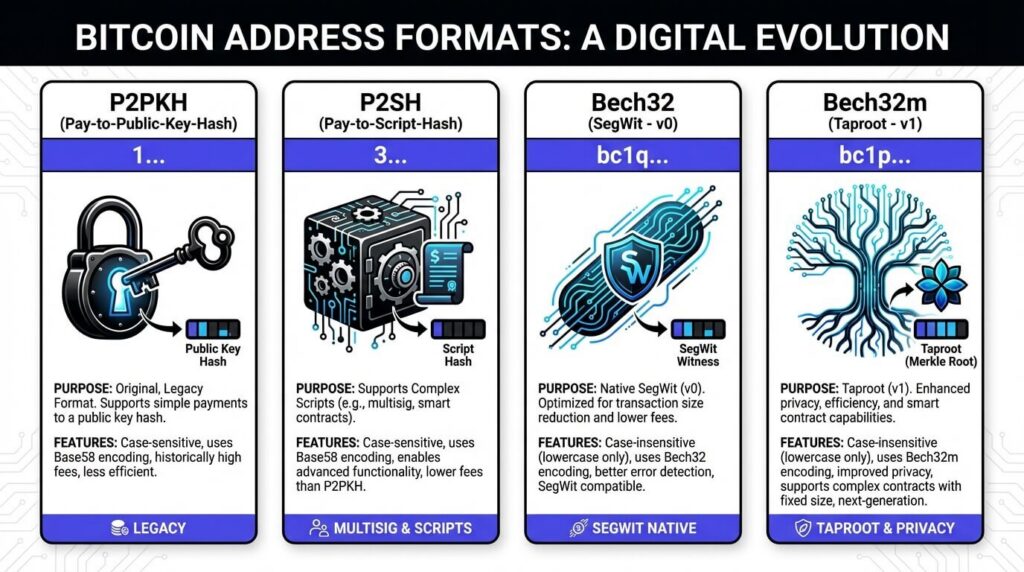
As the Bitcoin protocol changed over time, many different address forms have been added:
- P2PKH—Starts with “1”; the original format used in early wallets.
- P2SH—Starts with “3”; supports features like multi-signature transactions.
- Bech32 (SegWit)—Starts with “bc1”; enables more efficient transactions.
Bech32m (Taproot)—Starts with “bc1p”; adds more privacy and script flexibility.
Each type is a distinct means of encoding data and adding new features while still being able to work with prior versions of the protocol.
The Structure of a BTC Wallet Address
There are many different formats of Bitcoin addresses, each with its unique structure and technical features. Over time, these formats were added to accommodate new features, including better privacy, faster transactions, and more complicated forms of transactions.
All forms of addresses serve the same purpose: to show where Bitcoin transfers are going. Their lengths, prefixes, and character sets may be different. Each format has information like the type of network, the version, and a checksum to help keep mistakes from happening.
These formats were designed to coexist, not to replace one another. Wallets typically choose which format to use based on their technical capabilities and the features they prioritize, such as compatibility, lower transaction fees, or enhanced privacy.
Legacy (P2PKH)
The Bitcoin network first implemented these addresses. The first number is “1,” and they use a mechanism called Base58Check to help find mistakes in the input. Even though they are still extensively used, they tend to make transactions larger and cost more than modern forms.
Compatibility (P2SH)
P2SH addresses, which were added later to make Bitcoin’s scripting capabilities better, start with “3.” This format made it possible to use more advanced features like multi-signature wallets without changing how wallets show or process addresses. It also employs Base58Check encoding, but it puts more logic inside the address itself, which makes it more flexible without destroying backward compatibility.
Bech32 (SegWit)
This format made things a lot more efficient. Bech32 is a smaller version that works with Segregated Witness (SegWit), a protocol breakthrough that makes transactions lighter. You can tell it’s Bech32 by the “bc1” prefix. The format uses a distinct encoding technique that only uses lowercase letters, which makes addresses easier to read and less likely to be typed incorrectly.
Bech32m (Taproot)
The Bech32m encoding format is used for Taproot addresses, which usually start with “bc1p.” This type supports advanced features introduced in Bitcoin’s Taproot upgrade, such as Schnorr signatures and improved script path privacy. Bech32m lets you make more flexible and private transactions without affecting the way Bitcoin transactions work at their core. It was made to be efficient, scalable, and able to work with smart contracts in the future.

How Are Bitcoin Addresses Generated?
Every Bitcoin address has a public and a private cryptographic key. The private key is made at random and kept as a secret. The public key, which is mathematically connected to the private key, is used to create the wallet address that anyone can see.
There are several steps in the process of changing a public key into an address:
- To begin, cryptographic hash functions are used to abbreviate and hide the public key.
- Then, depending on the address format, the result is wrapped with specific version data or scripting elements.
- Finally, the whole payload is changed into a format that the user can see, such Base58Check or Bech32, which has error detection built in.
Most wallets do this without you knowing. People usually only see the final address, not the processes that led to it.
All addresses in wallets that use hierarchical deterministic (HD) principles come from one seed phrase. This allows for the structured creation of many addresses from one root, based on standards like BIP-32, BIP-44, or BIP-84.
While the details of how to implement address generation may differ depending on the format, all address generation follows strict standards set out in Bitcoin’s protocol documentation. This guarantees that software that works with Bitcoin will always yield the same results when given the same input.
How to Send and Receive Bitcoin Without Risk
You need to know how to use and manage wallet addresses effectively to send or receive Bitcoin. Maintaining meticulous records of your addresses is essential for security and privacy, as transactions on the Bitcoin network are irreversible.
People provide the sender a real wallet address so they can get money. You can show this address as plain text or as a QR code for your personal convenience. Most wallets format addresses on their own and make a fresh address for each payment that comes in to keep your identity a secret.
When you transfer Bitcoin, the wallet software picks out unspent outputs that are available, puts the transaction together, and signs it using the private key. The network then gets the transaction. The transaction could fail or go to the wrong address if the address is typed in wrong or formatted inaccurately. In these situations, recovery is not achievable unless the unintended recipient helps.
Responsible address handling includes the following:
- Using newly generated addresses for each payment
- Verifying the address structure before sending
- Avoiding manual entry where possible to prevent typographical errors
When used together, these steps help lower the chances of transmitting money to the wrong person or making wallet activity public on the blockchain.
How to Verify a Valid BTC Address
To avoid sending a Bitcoin transaction to the wrong address, the receiving address must be validated for legitimacy first. Address verification confirms that the input follows known structural patterns and passes fundamental integrity checks set by the Bitcoin system.
There is a certain way to write each type of address, such as legacy (the original Bitcoin address format), SegWit (short for Segregated Witness, which improves transaction efficiency), or Taproot (a newer address type that enhances privacy and smart contract capabilities). Verification tools look at things like the prefix, length, and internal checksums of an address to make sure it hasn’t been mistyped or corrupted when it was copied and pasted or entered by hand.
This validation is built into a lot of wallet software and block explorers, which usually stop a transaction from going through if the address is wrong. But just because an address passes validation doesn’t mean that it is active, has been used previously, or belongs to a known entity.
Bitcoin is pseudonymous, so you can’t tell who owns it or what they’re doing by looking at the address. This is why it’s necessary to double-check the source of an address using outside sources, especially when big payments or payments from other people are involved.
Example of a Bitcoin Address in the Real World
You usually see Bitcoin addresses when you send or receive money through a wallet app. Here is a sample of a native SegWit address in the Bech32 format:
bc1qw508d6qe…0c3q5
You can share this kind of address as text or a QR code, and it is usually used to get payments. Wallets typically show it next to a label or amount to help people avoid making mistakes when they copy or scan it.
In actuality, the wallet software makes addresses like this automatically, and they may change with each transaction to protect your privacy. The prefix (bc1) indicates the format, but users usually don’t have to figure it out. Wallets check things in the background.
Addresses that start with “1” or “3” have different formats but serve the same purpose: they tell you where a transaction is going.
Before you finish a transaction, you need to make sure the address is correct by looking at it. Software usually stops people from using faulty addresses, but sending money to an address that is technically acceptable but wrong might still mean losing it forever.
FAQs About Bitcoin Addresses
Can a Bitcoin address expire?
Bitcoin addresses themselves do not expire, but some platforms may impose usage limits. Custodial services, which are third-party platforms that hold users’ cryptocurrencies, often restrict address reuse or deactivate them after a period of inactivity. In contrast, non-custodial wallets allow indefinite access, though rotating addresses is considered best practice.
Can ownership of a Bitcoin address be verified?
No, Bitcoin addresses are not real names. The protocol doesn’t support associating identities without more information or off-chain data. Blockchain analysis can’t confirm who owns an address, even though all transactions are public.
What if you type the wrong Bitcoin address?
If you input the address incorrectly and the checksum validation fails, most wallet software will stop the transaction. However, if you use a legitimate but incorrect address, the transaction will proceed, potentially resulting in irreversible loss of funds unless the recipient intervenes.
How can you tell if a Bitcoin address is legitimate?
There isn’t a single list of “legitimate” addresses. Format checks can tell you if something is technically correct, but not if it is real. Always check addresses using encrypted means, and don’t copy them from sources you don’t trust.
What’s the difference between address types when sending Bitcoin?
Some older services don’t work with newer address formats like Bech32. When wallets run into compatibility problems, they usually let the user know or suggest switching to a format that works. Most of the time, contemporary wallets automatically manage format compatibility.